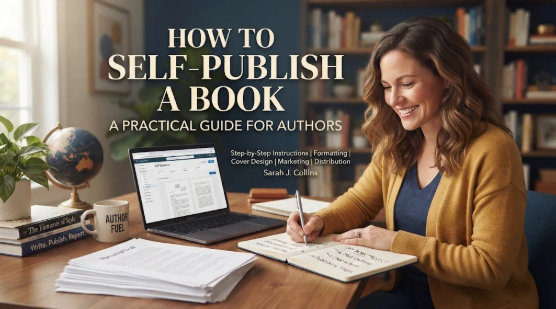

Self-publishing enables writers to take control of their work without having to enter into any contract with publishers. This allows authors to oversee editing, formatting, cover designing, publication, distribution, and marketing without having to wait for a publishing company to agree to publish their manuscript. It is important for authors to understand each step involved in publishing.
What Is Self-Publishing and How Does It Work?
Self-publishing is a mode of publishing that involves the author having the obligation to bring a book to its readers. This mode involves preparing the manuscript, editing the manuscript, designing the book cover, formatting the interior pages, deciding on the publishing platforms, pricing the book, and marketing it.
The author may choose to publish his/her books as ebooks, paperback, hardcover, or other formats at once. For instance, Amazon Kindle Direct Publishing (KDP) enables the author to publish his/her book in both ebook and print format using Amazon as the platform.
How Should You Prepare Your Manuscript Before Publishing?
Begin with a fully completed manuscript instead of attempting to publish the work when the book is not yet finished. The completed manuscript needs to undergo various stages of critique and revision before uploading to the publishing site.
The process of professional editing will be able to discover structural issues, ambiguity in the writing, repetitions, grammatical problems, and inconsistencies in the book. Proofreading is yet another way to catch spelling and typographical errors in the manuscript.
Another key step is that of checking for the organization of the manuscript. Each chapter has to be organized in order, the headings must all be uniform, and the front and back matter have to be ready.
See also: How Flat Roof Coatings Can Help Prevent Leaks and Extend the Life of Commercial Roofing Systems
What Book Design and Formatting Do You Need?
A book needs more than a polished manuscript to look professional. The cover should communicate the book’s subject and genre while remaining readable as a thumbnail in online stores. Interior formatting should also match the selected format.
An ebook requires responsive formatting because readers may view it on different screen sizes and devices. Kindle books, for instance, should be checked on different devices or preview tools before publication. Print books require attention to trim size, margins, page numbers, fonts, spacing, and print-ready files.
Which Self-Publishing Option Should You Choose?
It all comes down to the level of control, help, and time that one is willing to commit to personally.
| Option | Key Strength | Major Weakness | Who it’s Good For |
| Self-publishing | Maximal control | Author does most of the work | Experienced or hands-on writers |
| Professional help with publishing | Specialist knowledge available | Higher initial costs | Authors who need help |
| Traditional publishing | Publisher takes care of most production aspects | Competitive and minimal control | Authors who want to publish traditionally |
| Hybrid publishing | Combination of author control and professional services | Good choice of services necessary | Authors who need help in certain areas |
One should think about which services are needed before deciding on the option. The author can manage the distribution but needs professional editing or cover design.
How Do You Publish an Ebook and Print Book?
The final stage is when the manuscript file and design files are ready and one needs to register for the appropriate publishing platform and provide the necessary metadata, which may involve providing information on the book’s title, its author, description, categories, keywords, prices, and publishing rights.
In the case of the Kindle device, KDP enables the publication of ebooks and print-on-demand books. The author uploads the necessary files, reviews the digital or print version of the book, chooses prices and distribution options, and publishes the book.
Publishing the book in print-on-demand form is beneficial since books are printed when there is an order, unlike purchasing an entire stock upfront. However, it is advisable to review the proof of the book if available.
What Should You Do After Publishing?
Publication is the start of the availability of the book and not its final stage. Authors must have a strategy to help their readers find out about the book.
This starts with creating an author’s website or profile, a book description, promotional images, and related social media material. Based on the genre and the target audience, authors can utilize email marketing, online forums, book reviews, interviews, events, and even advertising.
Monitor sales information and reader feedback after launch. If the book description, cover presentation, pricing, or promotional approach is not producing the expected response, these elements can be reviewed and improved.
Authors who want structured assistance can also consider British Self Publishing when they need professional support with different stages of the publishing process.
How Can Authors Avoid Common Self-Publishing Problems?
Many publishing problems come from rushing the process. Publishing an unedited manuscript, using unsuitable formatting, selecting an unclear category, or overlooking the final proof can affect the reader experience.
Another common issue is treating marketing as an afterthought. Building awareness before and after publication gives the book more opportunities to reach its intended audience. Authors should also understand platform requirements and retain copies of their original manuscript and final publishing files.
When professional assistance is required, self publishing services can provide support with areas such as editing, design, formatting, publishing preparation, and related production tasks. Authors should review exactly what each service includes before making a decision.
Where Can You Get Help With Self-Publishing?
The extent to which an author requires assistance is based on experience, budget, timeframe, and the publishing objectives of the author. There are some authors who can accomplish a lot of things alone, whereas other authors need specialists that can do specific things for them.
An effective way to find out what stages require professionals is by knowing which stages require time savings or improvement in terms of quality.
To learn more about publishing assistance, click here:
www.britishselfpublishing.co.uk
Conclusion
Self-publishing provides a viable option for authors between having finished writing a book and its publication while retaining considerable control in the process of publication. The trick lies in perceiving the process of publication as a set of related steps, namely, editing the manuscript, creating professional design and formatting, choosing suitable platforms, checking final files, and forming an adequate marketing strategy. Proper preparation can make the process of publication more structured.